Hire engineers who can ship reliable software with AI.
AI-Native Engineering Skills measured in full agentic workspace — not just prompting.


 & more· Anti-cheat·
Capable AI fluency; Python and FastAPI demonstrated, with LangChain and Testing needing validation.
Every resume looks the same. Video Q&A can't catch a rehearsed, AI-assisted answer.
Resumes & video Q&A can't predict who can actually build.
We tested candidates against their own résumés — the stronger the résumé, the wider the gap.
Based on 1,000+ actual assessments completed by candidates across coding and non-coding roles.
Skills-based assessment closes the gap.
Give candidates a real task in a real AI IDE and measure what they can actually ship — not what they claim.
Full skill-and-stack scoring, code review, and video Q&A live in the sections below.
AI can make the work look easier than it is.
VIBE CODING / AI CODING
AI can generate code that runs while hiding weak architecture, debugging, security, or ownership.
We combine AI collaboration signals — plan, steer, review, iterate, and validate what AI built — with code and stack review plus evidence of selected engineering skills demonstrated in the task.
AI NON-CODING
A polished memo, analysis, or plan can hide shallow role knowledge and weak subject-matter judgment.
We use role-specific tasks and artifacts to score subject-matter accuracy, decisions, and outcomes, not just writing quality.
UNDERSTANDING WHAT AI DID
Candidates can produce polished output without understanding the reasoning, limitations, or tradeoffs behind AI-generated work.
We assess whether candidates can explain, validate, and improve what AI produced, not just accept the output.
HUMAN CONTRIBUTION
A strong final result can hide how much value the human actually brought to the work.
Our human contribution signal shows how candidates frame the problem, make decisions, direct AI, and improve the final outcome.
AI in hiring raises questions about fairness, evidence, and who makes the decision.
VibeLevel is designed around observable work and reviewable evidence — not biometric video analysis, resume claims, or an automated hiring verdict.
HUMAN DECISION OWNERSHIP
AI should not decide who gets hired — and inferred traits can turn an assessment into a black box.
VibeLevel produces structured evidence and written scoring context. Hiring teams keep responsibility for interpretation and the final decision.
TASK-BASED, NOT TRAIT-BASED
Personality, culture-fit, and other inferred traits can introduce subjective or difficult-to-defend signals.
We evaluate observable, job-specific behaviours during a structured task: how candidates plan, build, review, test, and improve their work.
IDENTICAL ENVIRONMENT
Different tools, prompts, or test conditions can create environmental variation that has nothing to do with the role.
Candidates receive the same workspace, task, AI assistant, and scoring rubric, creating a more consistent basis for comparison.
EXPLAINABLE SCORING
A score without context is hard for a hiring team to review, question, or use responsibly.
Each dimension includes a written AI-generated justification tied to the submitted work, giving managers evidence to inspect rather than a verdict to accept.
These principles support responsible, job-related assessment design; they are not legal advice or a substitute for jurisdiction-specific legal review.
AI-fluency assessments with real Claude Code & Copilot workflows.
Candidates work in the same agentic tools your engineers already use — not a synthetic prompting quiz or a multiple-choice test.
- ✓Full IDE: file tree, terminal, test runner, AI agent
- ✓Approved tools: Claude Code, GitHub Copilot, Claude
- ✓Every prompt, edit, and test run is captured
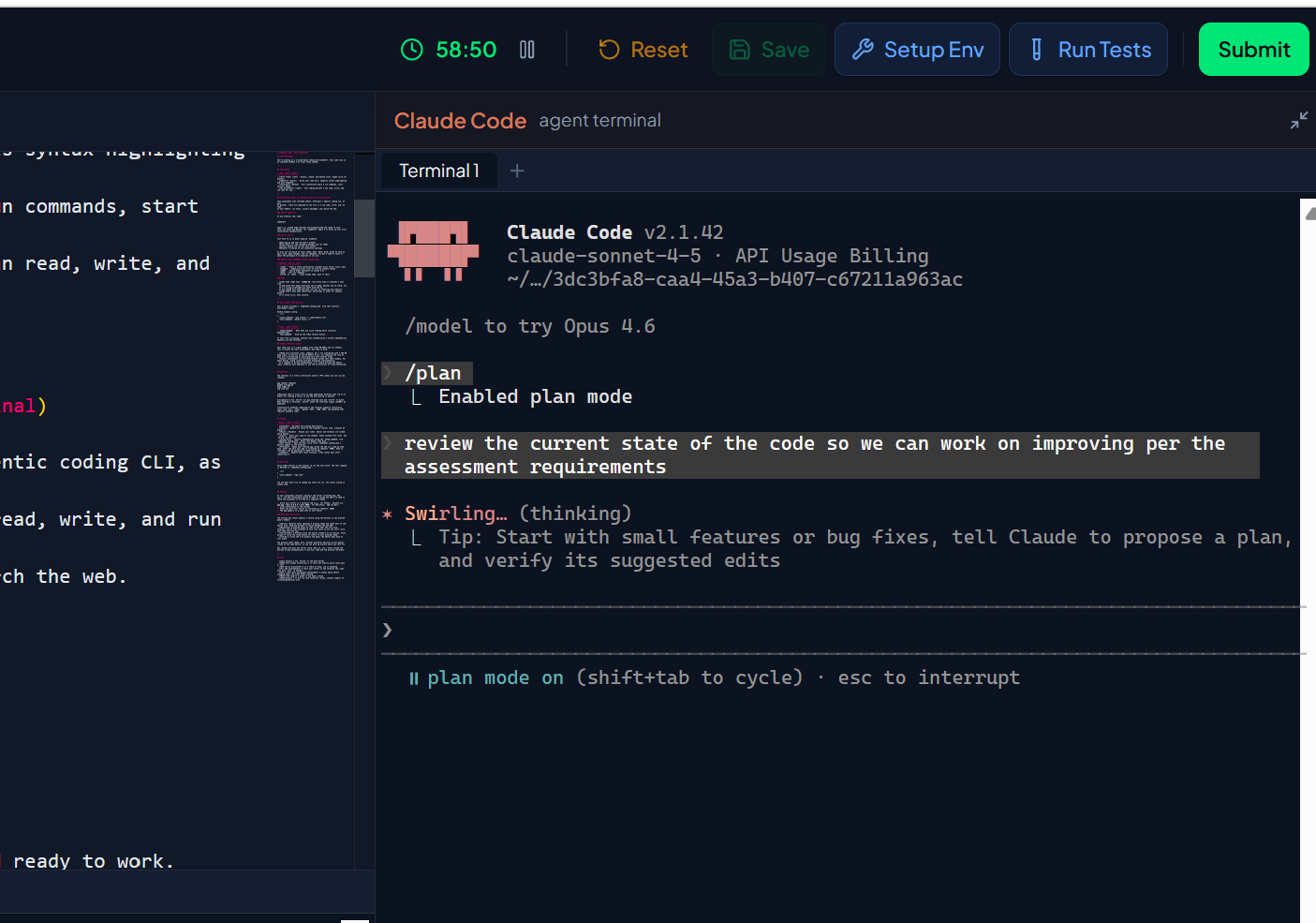
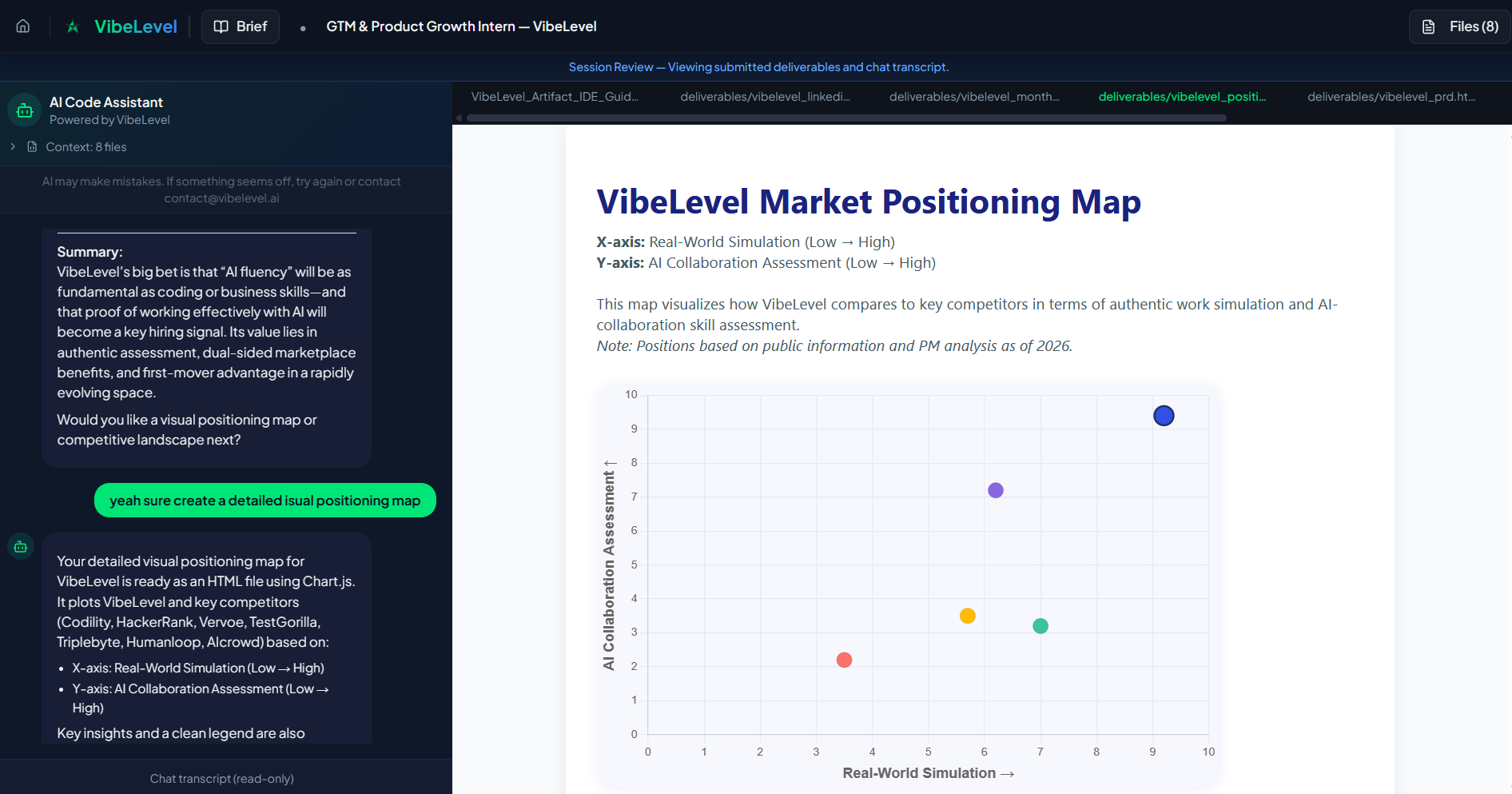
Full agentic workspace. Production-grade assessments built from your job description, stack & skills.
Tasks are scoped to your actual stack and tickets — not a puzzle site. Coding roles get a real IDE; non-coding roles get an artifact workspace with the same evidence model.
- ✓Role-specific tasks built from your stack and workflow
- ✓Coding + non-coding roles on one platform
- ✓Same contribution and quality signal either way
Advanced signals, not just an AI-prompting score.
Most tools stop at one overall number or a prompt-writing score. VibeLevel measures AI fluency alongside the engineering judgment needed to work with AI, plus the role-specific skills and subject-matter expertise each job requires — for coding and non-coding roles alike.
- ✓AI fluency plus engineering judgment: plan, review, debug, and iterate with AI
- ✓Role-specific skills and subject-matter expertise for coding and non-coding work
- ✓Human contribution and work quality evidenced through decisions, artifacts, and outcomes
The candidate's own engineering and product judgement — evidenced skill by skill, not inferred from the final artifact.
How well they directed the assistant — not who typed the code.
Target skills are drawn from a structured taxonomy, calibrated to the stack, role and level — and every verdict carries evidence from the work itself.
Four questions behind every score.
Not a prompt wrapped around a language model. A skills- and evidence-based evaluation engine, built and calibrated over twelve months and thousands of real-world assessments.
- ✓Did they demonstrate the skills?
- ✓Is the work reliable?
- ✓Did they drive it, or did the AI?
- ✓Do they understand what they built?
See exactly where your pipeline is stuck — and who's actually strong.
A live dashboard tracks every candidate from invite to shortlist, shows score distribution across skill levels, and breaks performance down by dimension and skill — so you always know where to focus.
- ✓Funnel view: invited → started → submitted → shortlisted, with drop-off flagged
- ✓Score distribution across Novice → Advanced, with shortlist rate per level
- ✓Skill and dimension breakdowns showing exactly where candidates are strong or weak
- ✓Skills missing in sourcing — see which required skills almost no one demonstrates
- ✓Per-recruiter / hiring-manager view — compare average score and shortlist rate across your team
Identify who can actually ship with AI
Role-relevant work samples in a real AI workspace — before your team spends time in technical interviews.
Practice. Earn evidence you can share.
Practice in a real AI workspace, understand how you work with AI, and earn shareable skill evidence.
AI-ready students, proven to employers
Campus-wide AI vibeathons and leaderboards, with a coordinator dashboard and top performers surfaced to hiring partners.
Frequently asked questions
What is VibeLevel?
VibeLevel is an AI-native skills assessment platform. It turns real AI-enabled work into evidence: individuals can practice and build shareable skill signals, while hiring teams can evaluate how candidates use AI to plan, build, review, test, debug, and ship reliable work.